Day 6 - Nightwatch
As I write these words, I’m sitting outdoors in the dark night of a desert. To the East, beyond the dirt road that led me here, across miles of occupied desert valleys, are the twinkling city lights of Jordan. On the other three sides, I’m surrounded by a small hill that I cannot see over. At any moment, a shadowy figure might appear or car headlights might flash down the dirt road. My job is to yell “mustawtin,” awaking the Palestinians whose land I’m on, awaking them to relive the nightmare of March 13, 2026. For context:
- Thirty masked settlers invade Palestinian property in Humsa
- 30 settlers violently attack Palestinian family and International activists in Humsa, Jordan Valley
I come armed with a high-powered flashlight, an acute sense of alertness, and a mouth to scream with. The articles above mention a family of twelve, but since the attack, most moved to a city so they can get some sleep. Awake with me are the two Palestinian brothers who formerly grazed the $350,000 worth of sheep set loose by the settlers. I get a break when my partner L wakes up from her nap in large tent formerly housing 100 sheep. But the brothers, laying on the rocks near the hill, have the bravery to resist the luxuries of sleep every night. One of them is watching what sounds like an Arabic sitcom. I can relate.
It’s silent here. In a better world, this would be a perfect place to watch the stars. I’ve been told the sunrises are great.
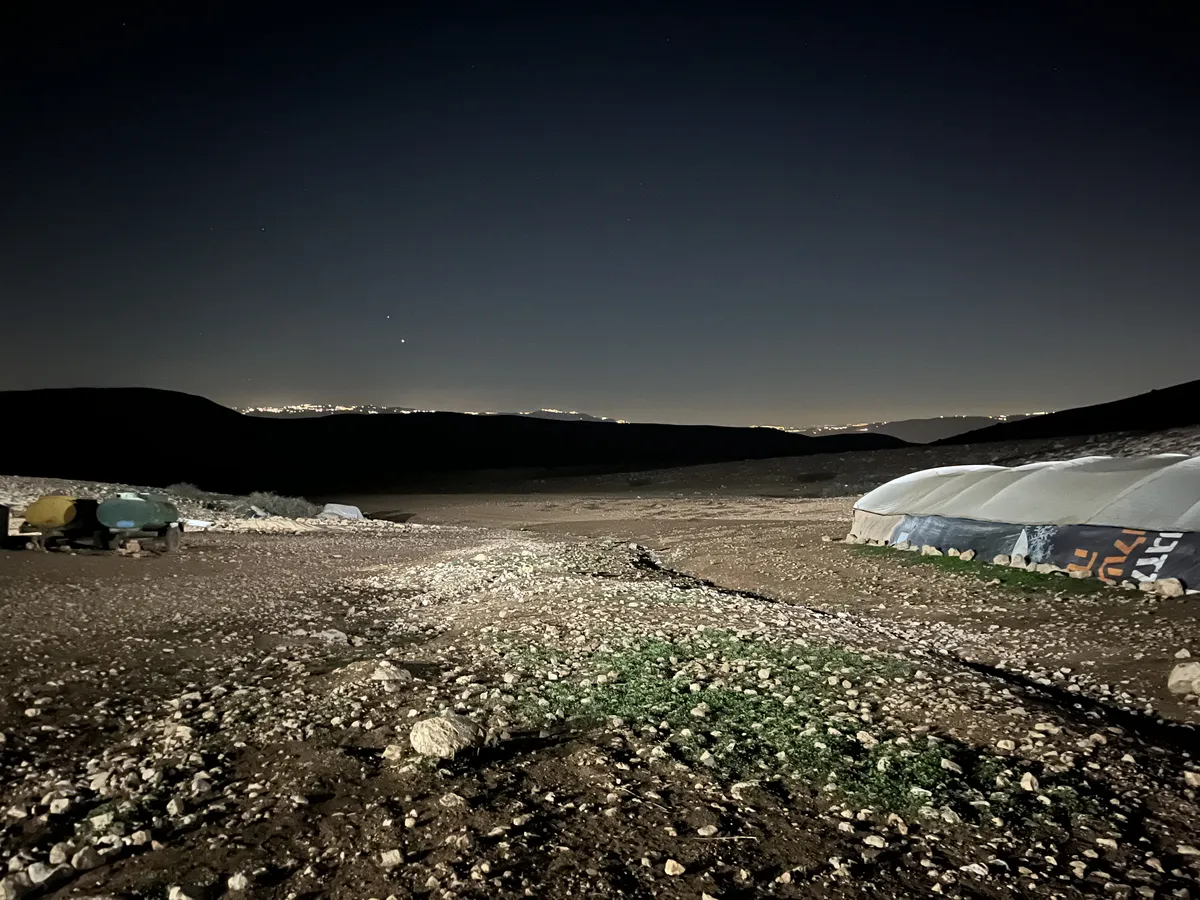 The East, where the sun will rise. Jordan is in the distance.
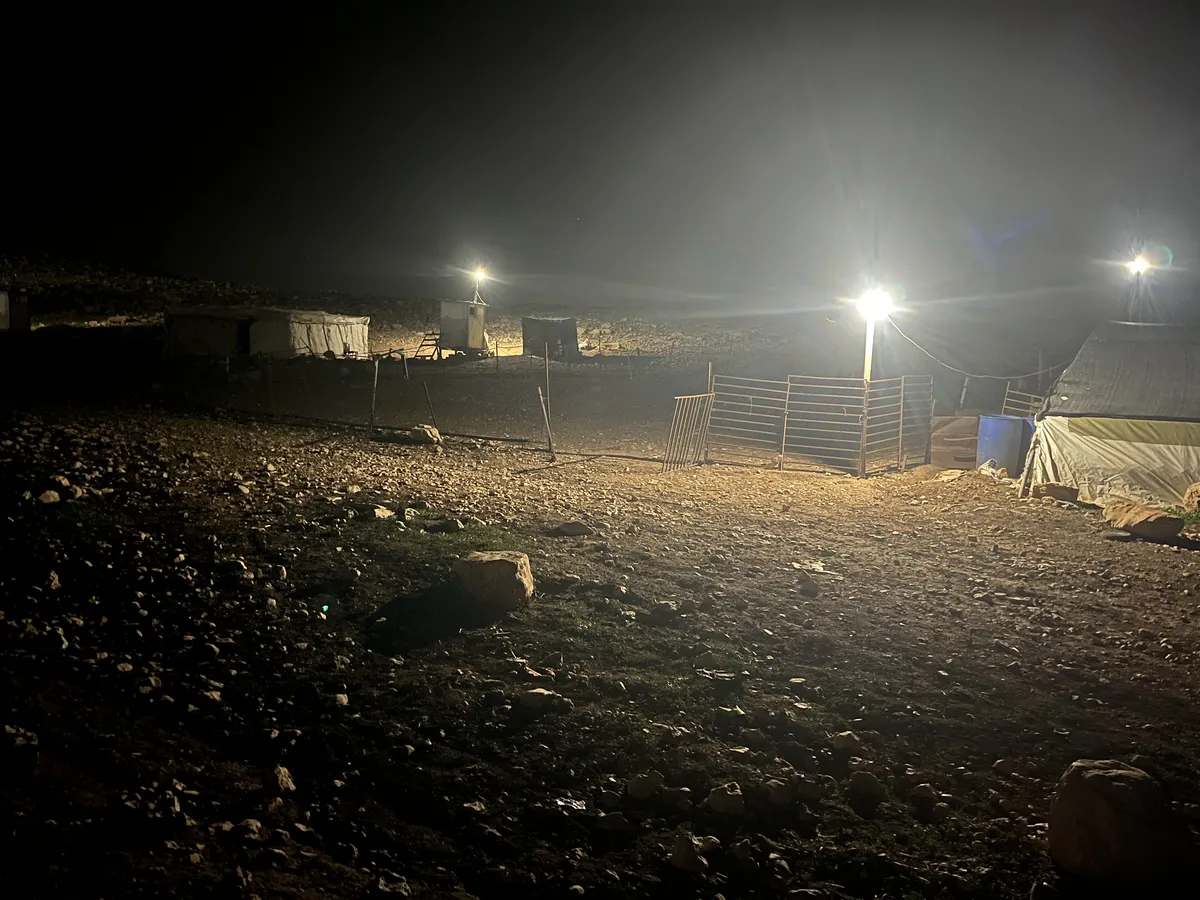 The North, where I’ll go in the morning when nightwatch is finished.
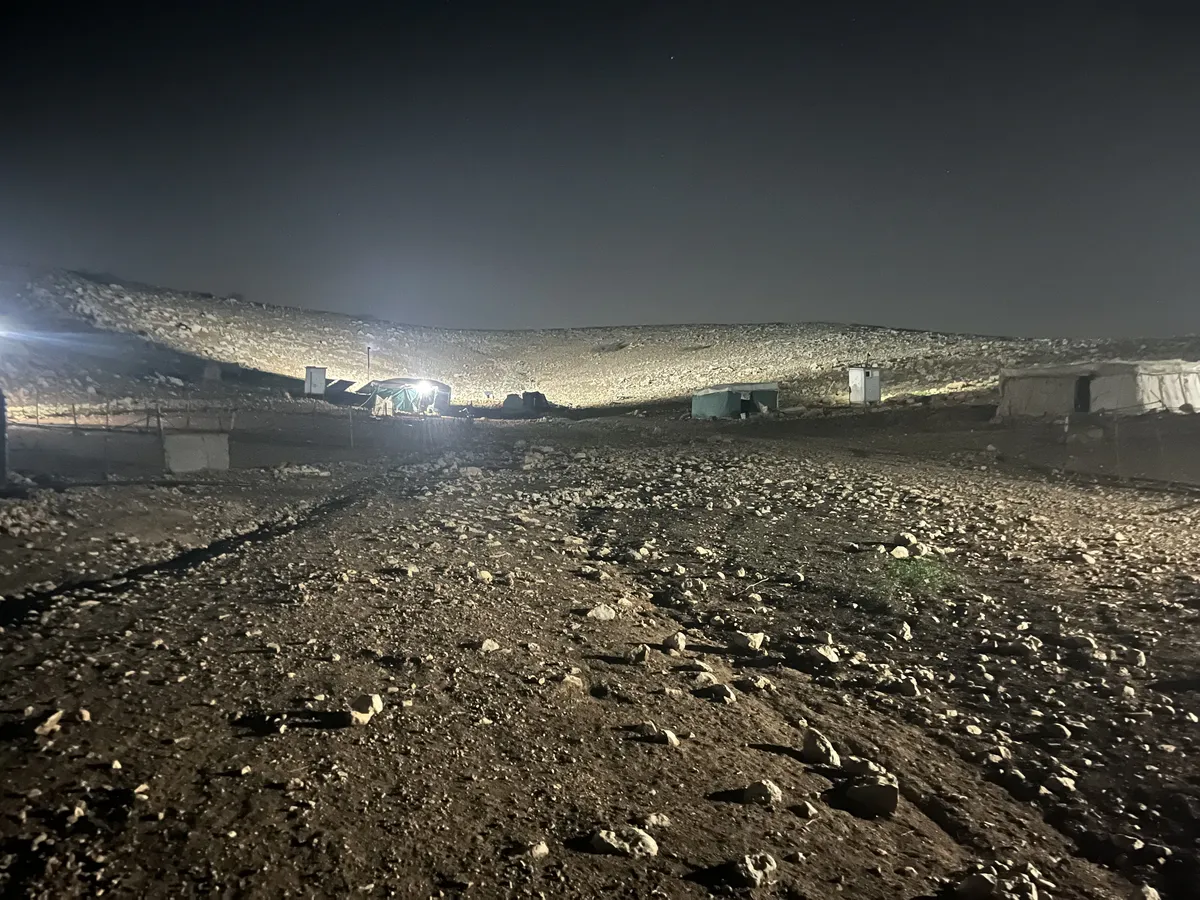 The West, where 30 masked settlers descended from on March 13th, where the sun will set.
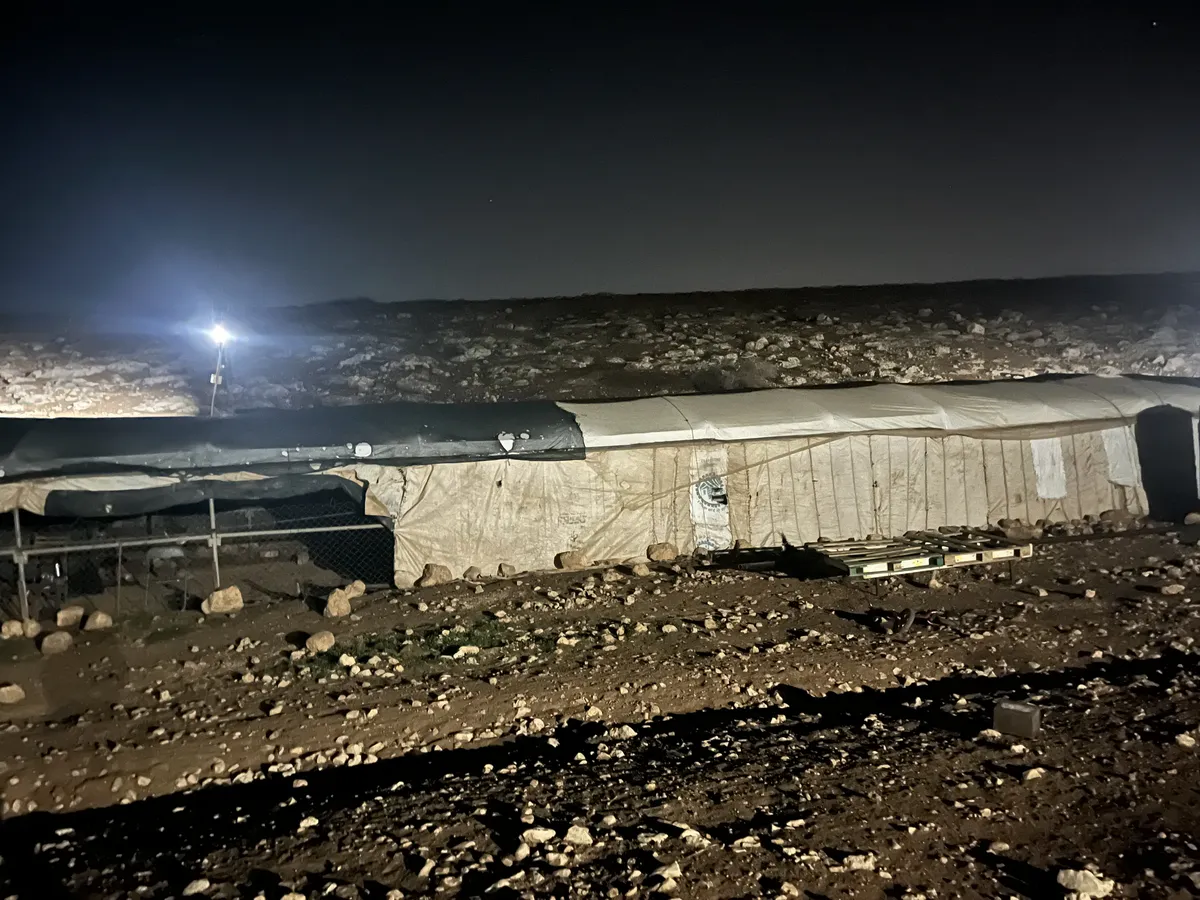 The South, where my partner sleeps with the memories of sheep.
Earlier today, my training group went our separate ways to our assignments. Four of us including me when to a village in Varsity; the other two went to separate locations. The drive here taught me a lot. The taxi drivers take long, winding paths through the mountains to avoid checkpoints. Not just because it’s safer, but also because it’s quicker to drive out of your way on remote roads than to leave it up to the Occupation. Luckily, we passed no checkpoints. If we had, we all would act like ignorant tourists who just met. Driving through Varsity gave me some perspective that I don’t think I can properly explain in words. You must see it and be there to understand. What I mean is that there are settlements. Colonies. Outposts. Everywhere. I knew there were a lot before I came. What I saw was more than a lot. Throughout the desert, the settlements are more noticeable than the Palestinian homes and villages. Sometimes they are small outposts, shacks with crude and glaring flags of the Occupation. Sometimes they are enormous, like plantations or compounds. Massive greenhouses and farmland, watchtowers and bunkers, barbed wire fences and military vehicles. There are more Israeli license plates than Palestinian plates by far. Along the road, there are hundreds of billboards advertising for adventurous war criminals to come join in on the fun. One particularly large one had an AI generated real estate agent showing off an ugly but perfect condominium. The street signs are written in Arabic, Hebrew, and English, but it’s hard to tell because so many have the Arabic crossed out or otherwise vandalized. There’s posters everywhere of Itamar Ben-Gvir (I’m not double checking if I spelled his name write because fuck that bitch), a figure of political aspiration among these depraved war criminals.
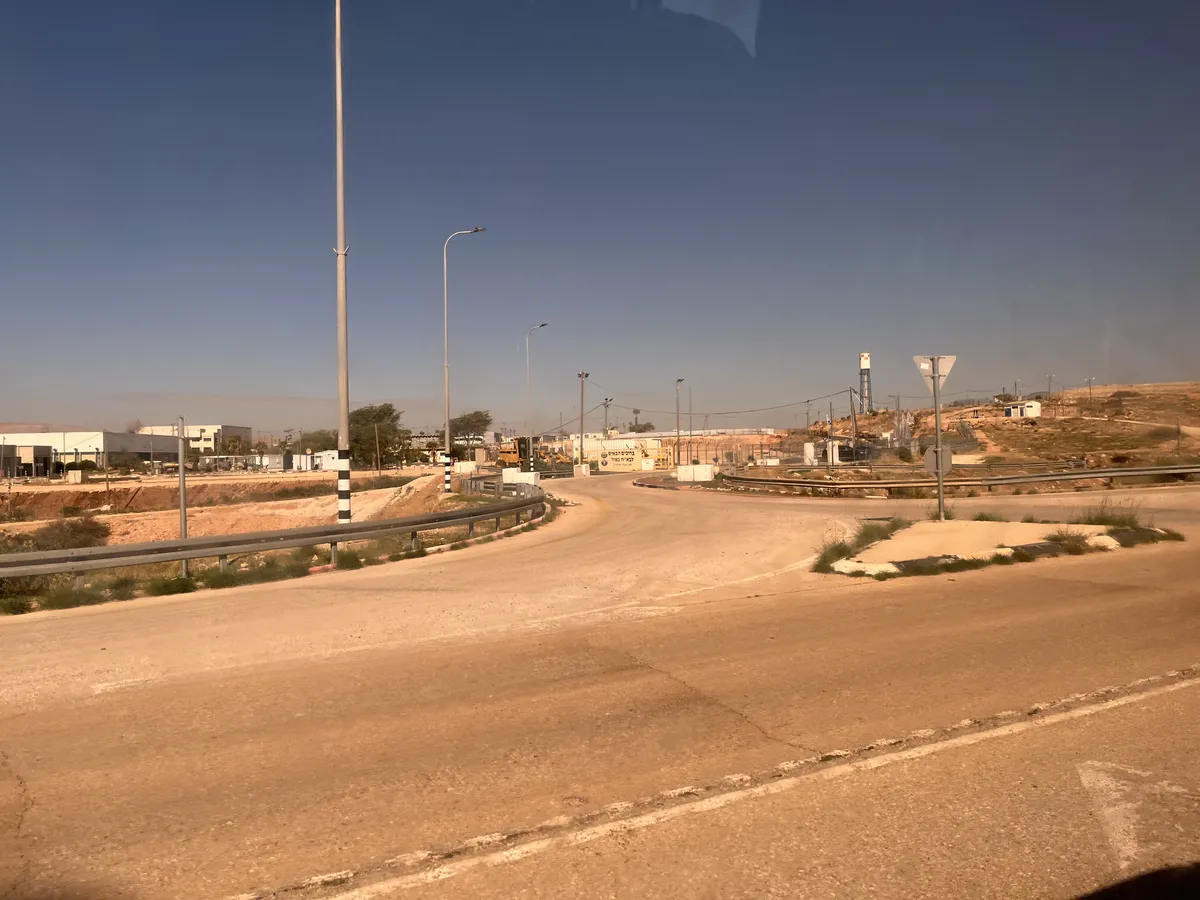 The entrance to a settlement, recognizable by its barbed wire fences, Hebrew sign, and ugly ass building.
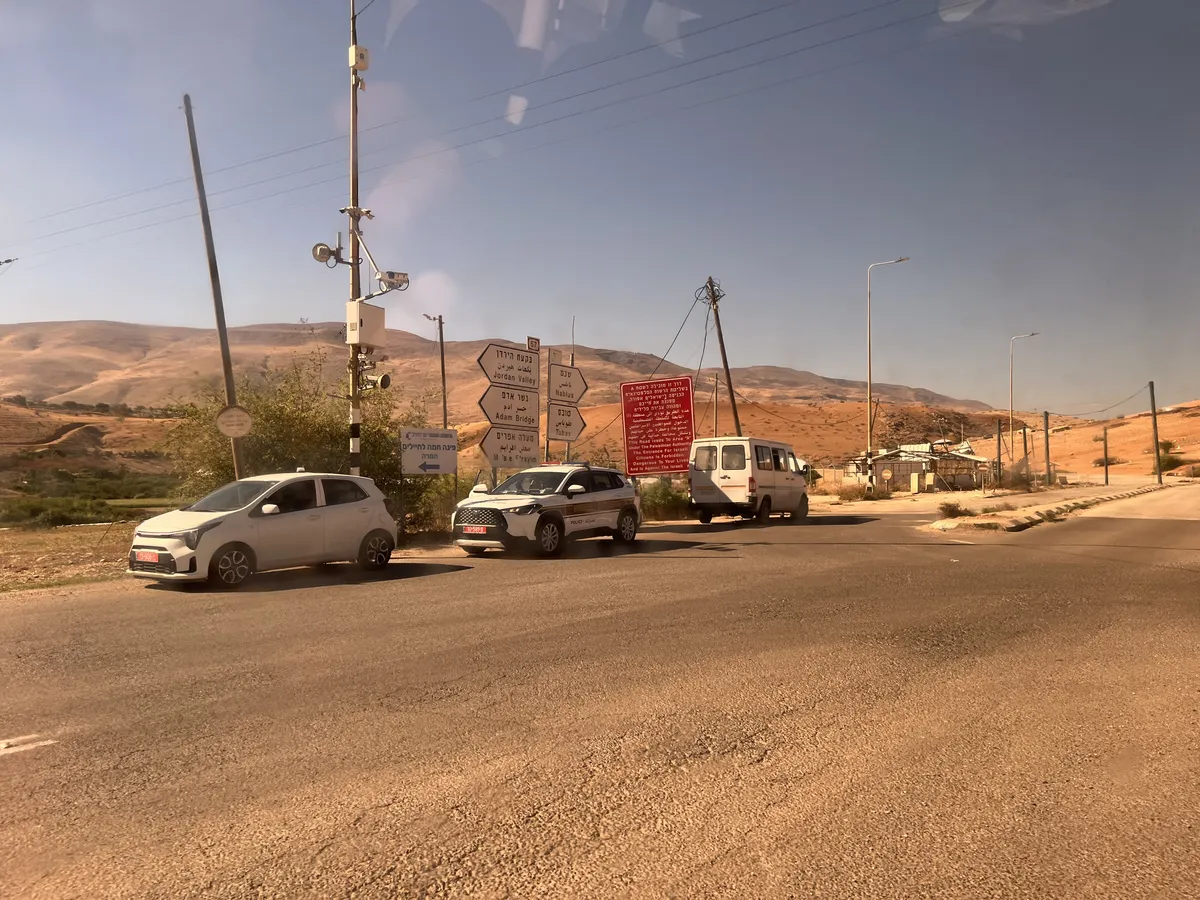 Two Israeli shurta (police; on the left) and a Palestinian vehicle (on the right). Note that the “Area A” referenced by the sign is nothing actually dangerous, it’s just an area under the governance of the Palestinian Authority, which mostly function to suppress anti-Israeli sentiment and violence anyways.
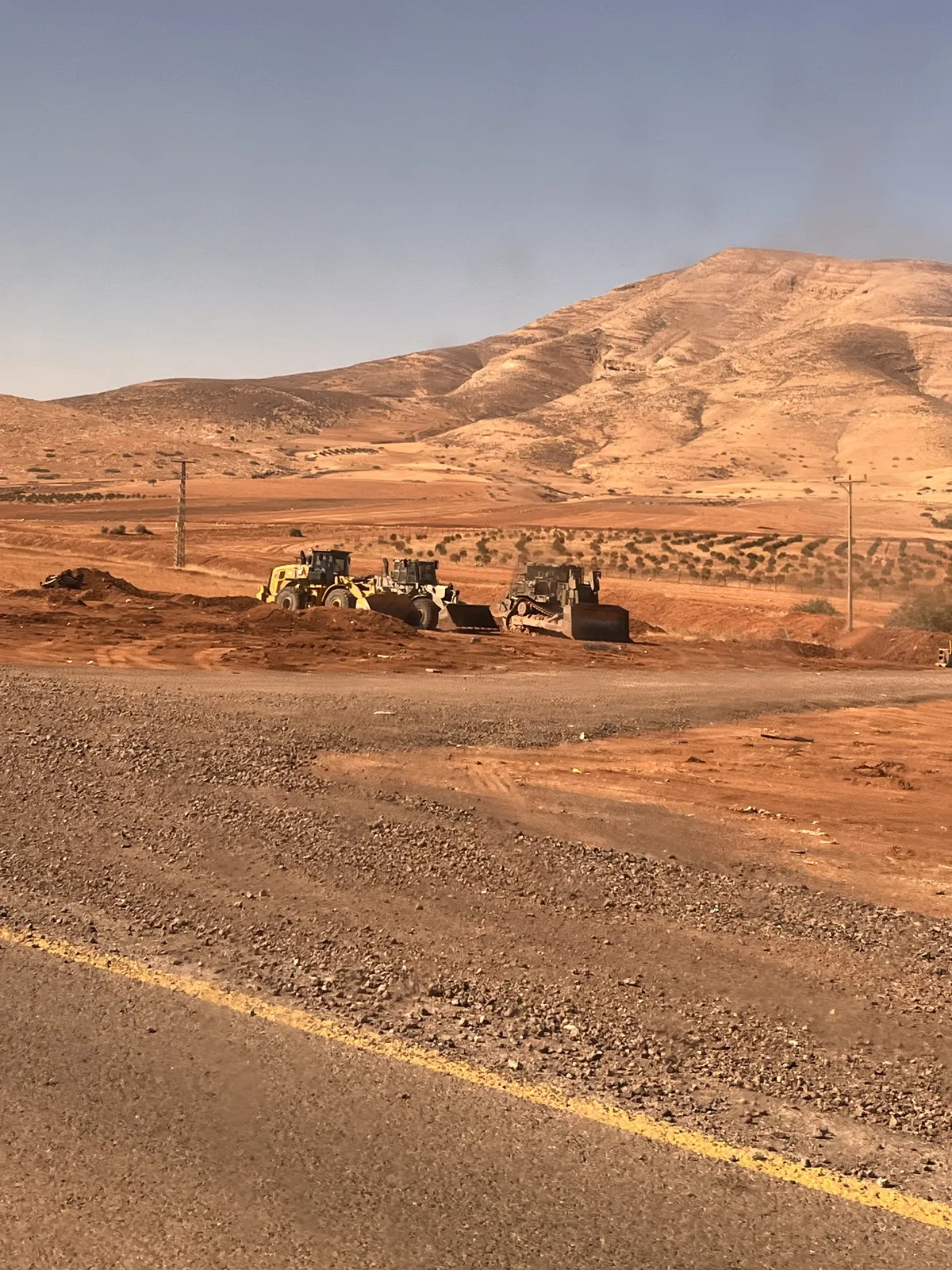 Three bulldozers. The one on the right is specially designed by Caterpillar for the IOF and armored to demolish Palestinian homes. In 2003, an activist doing something similar to me was murdered by a settler who ran her over while she was attempting to block the demolition of a Palestinian home. Afterwards, Caterpillar paid for private investigators to spy on her family.
After a two hour drive, we arrived at the village in Varsity that functions as our home base. We’ll call it Puppy. Puppy is a smaller community, but still larger than the other areas we do nightwatch at. Puppy requires a nightwatch even though no Palestinians stay there full time because there is a settler outpost very close by. Every day, after we’ve return from nightwatch, we go to sleep at the house in Puppy. It doesn’t have enough beds for everyone, so we have to take turns. Here at the Puppy House I met a new cast of volunteers. I haven’t spoken much with any of them besides L, who was assigned as my partner for tonight. L is a teacher like me, and we seem to share many beliefs and experiences regarding our educational careers. While at the Puppy House, we ate dinner, had meetings to introduce ourselves and get our assignments, and had a second dinner with some locals. G told me during the first dinner that she has a friend, a pornstar from Hong Kong named Viva Athena, who has the exact same tattoo as me. Once again, there was a lot of confusion regarding my gender, which is once again understandable, but I think in some cases it is hindering my first impressions with some Palestinians. Hopefully I can mitigate that by learning more Arabic. Around the time it got dark, L and I left Puppy for our nightwatch assignment. Things have been simple since we got here. We chatted with the family, had a third dinner, L explained the rules to me, and she’s asleep for another hour, after which I wake her up and we swap. We get picked up around 6:30 a.m.
There’s not much else I can think to add for my day. But, if you are interested, I have a suggested reading: The Right to Speak for Ourselves by Mohammed Al-Kurd. It is not long. I’d highly recommend. It pertains to something I’ve been considering since I began writing about Palestine.